
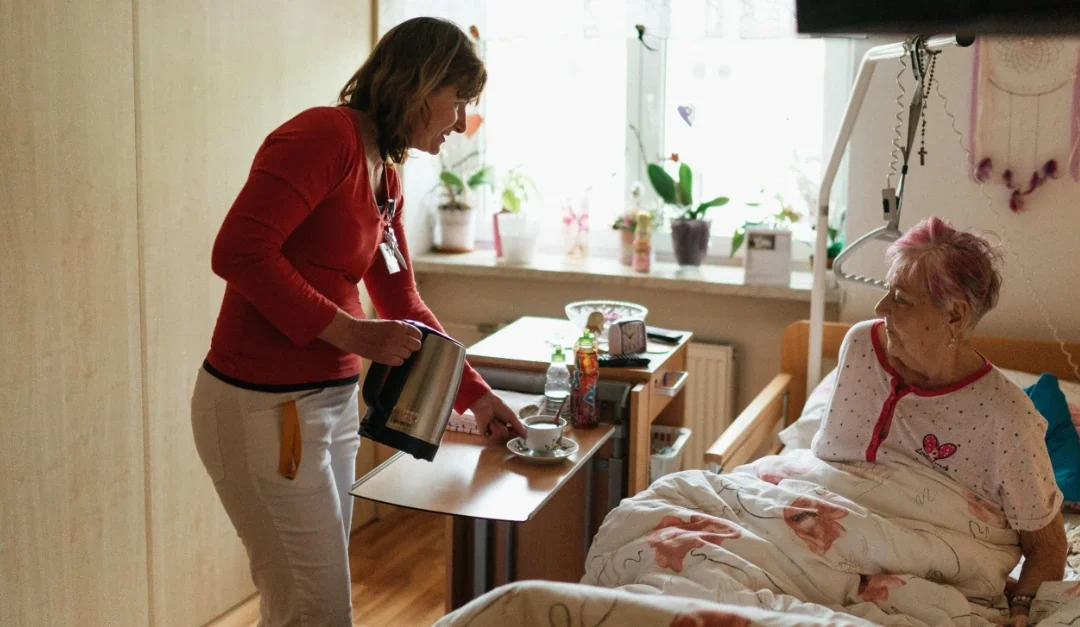
When you spend your days taking care of everyone else, it’s worth asking a question that rarely gets asked out loud: who is looking after you?
Caregivers tend to be remarkably good at noticing what other people need. They catch the shift in a loved one’s mood, keep the medication schedule straight, anticipate the hard moments before they arrive, and quietly manage a hundred responsibilities no one else ever sees. Turning that same attention inward is much harder. For many caregivers, exhaustion becomes so familiar that it stops registering as a problem at all—it just feels like the way things are now.
It doesn’t have to reach a breaking point before it deserves attention. Learning to recognize the early signs of caregiver stress can open the door to asking for help and adjusting responsibilities before exhaustion becomes entrenched. And one thing is worth saying clearly up front: burnout is not always solved by adding one more item to a self-care list. When a caregiver is managing broken sleep night after night, complex medical decisions, or responsibilities no one else shares, the meaningful change is often respite, coordinated family help, or a realistic shift in expectations. Emotional support matters—but the practical weight of caregiving deserves direct attention too.
What Is Caregiver Burnout?
Caregiver burnout is a widely used term for the emotional, mental, and physical exhaustion that can build when caregiving demands stay high and the opportunities for rest, help, and recovery stay low. It is not a formal diagnosis, and its symptoms can overlap with anxiety, depression, sleep difficulties, and other health concerns.
Caregiving itself isn’t inherently harmful. Many people find genuine purpose, connection, and meaning in caring for someone they love. The difficulty tends to arise when the role becomes prolonged, intensive, or unsupported—when there is simply more to carry than one person can sustainably hold.
Signs You May Be Experiencing Caregiver Burnout
Caregiver stress looks different from one person to the next, but some experiences come up again and again:
- Feeling exhausted even after resting.
- Becoming easily frustrated or overwhelmed.
- Having difficulty concentrating or making decisions.
- Carrying persistent worry about your loved one.
- Withdrawing from friends or activities you used to enjoy.
- Feeling numb, disconnected, or emotionally depleted.
- Noticing changes in sleep, appetite, or physical health.
- Feeling trapped between wanting to help and desperately needing a break.
You may also notice that you have less patience with the person you’re caring for, and then a wave of guilt about having reacted that way at all. These experiences deserve compassion rather than self-criticism. If symptoms persist or worsen, they’re also worth discussing with a healthcare professional.
Why Caregiver Guilt Can Make Burnout Worse
A lot of caregivers feel guilty simply for needing rest. The inner commentary tends to sound something like this:
“They have it so much harder than I do.”
“I should be able to handle this.”
“No one else can do it the way I can.”
“What kind of person feels frustrated with someone who needs help?”
Thoughts like these make it genuinely hard to recognize when responsibilities have crossed into unsustainable territory. But needing support is not evidence of insufficient love or commitment. It’s evidence that caregiving takes real energy, time, emotional resources, and often practical help. When guilt keeps a caregiver from setting limits or accepting assistance, exhaustion tends to deepen—and the guilt and the burnout start feeding each other.
Five Ways to Begin Addressing Caregiver Burnout
- Recognize the warning signs. Pay attention to shifts in your mood, sleep, energy, concentration, and relationships. Rather than waiting until you can’t continue, treat those changes as an early invitation to take stock of how much support you actually have.
- Identify what you can realistically control. You may not be able to change a loved one’s diagnosis, behavior, or circumstances. You often can change how responsibilities are organized, how help is requested, and which tasks you agree to take on in the first place.
- Build real opportunities for rest. Rest has to be more than one more task squeezed into an overwhelming schedule. Consider whether family members, community programs, professional services, or respite care could take genuine weight off your shoulders—not just for an afternoon, but as part of how the caregiving is structured.
- Challenge unrealistic expectations. Being a loving caregiver does not require doing everything perfectly. Notice the expectations that leave no room for being tired, frustrated, or human—and question whether anyone would actually hold you to them but you.
- Seek both emotional and practical support. Counseling, peer support, medical care, and community resources each do something different. Therapy can help you process the emotional experience of caregiving, while practical assistance can reduce the demands that are fueling your exhaustion in the first place. Both matter, and one rarely substitutes for the other.
How Counseling Can Help With Caregiver Burnout
Therapy offers something caregivers rarely get: a space to talk honestly without feeling responsible for protecting anyone else’s emotions. In counseling, you might work to:
- Recognize the patterns that keep chronic stress in place.
- Develop healthier boundaries and clearer communication.
- Work through guilt and self-criticism.
- Process grief, anger, resentment, or uncertainty.
- Build coping strategies and tools for emotional regulation.
- Reconnect with your own identity and the relationships that matter to you.
Just as importantly, therapy should never become one more expectation—one more thing you’re supposed to simply endure your way through. Sometimes real improvement also requires additional resources, a change in who does what, or more comprehensive support than any one person can provide alone. Good counseling helps you see that clearly rather than asking you to white-knuckle an impossible situation.
You Don’t Have to Earn the Right to Rest
There’s no award for reaching total exhaustion before you ask for help. You’re allowed to experience joy, connection, and rest alongside your caregiving responsibilities. You’re allowed to say that something is hard. You’re allowed to need assistance. And you’re allowed to care for yourself even while someone else is depending on you.
At Stella Luna Counseling & Wellness in Middleburg Heights, Ohio, our trauma-informed, holistic approach supports people navigating stress, emotional exhaustion, and complex life circumstances—including the caregivers who so often put themselves last. If you’re looking for caregiver counseling in the Cleveland area, we’d be glad to help you find a way forward that’s actually sustainable.
Caregivers deserve more than the strength to keep going. They deserve support that makes life livable.
Learn more about counseling at Stella Luna or reach out to our intake team.
References
- Effectiveness and Cost-Related Outcomes of Respite Care Models for People With Functional Disability and Dementia and Their Caregivers: A Systematic Review. Liu M, Yang Y, Chen Y, et al. The Gerontologist. 2026;66(9):gnag174. doi:10.1093/geront/gnag174.
- Association Between Community Elderly Care Services and the Physical and Emotional Burden of Family Caregivers of Older Adults: Evidence from Beijing, China. Gao X, Tang Y. International Journal of Aging & Human Development. 2024;99(2):247-262. doi:10.1177/00914150241238140.
- Effectiveness of an in‐home respite care program to support informal dementia caregivers: A comparative study. Vandepitte S, Putman K, Van Den Noortgate N, Verhaeghe S, Annemans L. International Journal of Geriatric Psychiatry. 2019;34(10):1534-1544. doi:10.1002/gps.5164.
- A comprehensive meta-review of systematic reviews and meta-analyses on nonpharmacological interventions for informal dementia caregivers. Cheng ST, Zhang F. BMC Geriatrics. 2020;20(1):137. doi:10.1186/s12877-020-01547-2.
- Diagnosis and treatment of occupational burnout in the Swiss outpatient sector: A national survey of healthcare professionals’ attributes and attitudes. Guseva Canu I, Getzmann R, Shoman Y, et al. PloS One. 2024;19(12):e0294834. doi:10.1371/journal.pone.0294834.
- Burnout and Depression: Two Entities or One?. Schonfeld IS, Bianchi R. Journal of Clinical Psychology. 2016;72(1):22-37. doi:10.1002/jclp.22229.
- The Relationship Between Burnout, Depression, and Anxiety: A Systematic Review and Meta-Analysis. Koutsimani P, Montgomery A, Georganta K. Frontiers in Psychology. 2019;10:284. doi:10.3389/fpsyg.2019.00284.
- Biopsychosocial impact of high levels of trait anxiety on family caregivers in the end-of-life palliative care setting. Grumeth AM, Rothenhäusler HB, Mörkl S, et al. PloS One. 2025;20(3):e0307349. doi:10.1371/journal.pone.0307349.
- The Impact of Dementia on Family Caregivers: What Is Research Teaching Us?. Merrilees J. Current Neurology and Neuroscience Reports. 2016;16(10):88. doi:10.1007/s11910-016-0692-z.
- Coping and Guilt in Informal Caregivers: A Predictive Model Based on Structural Equations. Muro Pérez-Aradros C, Navarro-Prados AB, Satorres E, Serra E, Meléndez JC. Psychology, Health & Medicine. 2023;28(4):819-830. doi:10.1080/13548506.2022.2029917.
- Perceived Help-Seeking Difficulty, Barriers, Delay, and Burden in Carers of People With Suspected Dementia. Ng CKM, Leung DKY, Cai X, Wong GHY. International Journal of Environmental Research and Public Health. 2021;18(6):2956. doi:10.3390/ijerph18062956.
- Compassion fatigue in family caregivers: a Wilsonian concept analysis. Lynch SH, Lobo ML. Journal of Advanced Nursing. 2012;68(9):2125-34. doi:10.1111/j.1365-2648.2012.05985.x.
- Assessment of burden and needs of family caregivers for the elderly, a scoping review. Le Toullec E, Le Gagne A, Leblong E, Somat A, Piette P. Frontiers in Aging. 2025;6:1578911. doi:10.3389/fragi.2025.1578911.
- Physician Health and Wellness. McClafferty HH, Hubbard DK, Foradori D, et al. Pediatrics. 2022;150(5):e2022059665. doi:10.1542/peds.2022-059665.
- Relieving care burden and promoting health-related quality of life for family caregivers of elderly people with Alzheimer’s disease via an empowerment program. Yazdanmanesh M, Esmaeili R, Nasiri M, Vasli P. Aging Clinical and Experimental Research. 2023;35(1):73-83. doi:10.1007/s40520-022-02277-8.
- The contribution of caregiver psychosocial factors to distress associated with behavioural and psychological symptoms in dementia. Feast A, Orrell M, Russell I, Charlesworth G, Moniz-Cook E. International Journal of Geriatric Psychiatry. 2017;32(1):76-85. doi:10.1002/gps.4447.
- Caregiver Burden and Dementia: A Systematic Review of Self-Report Instruments. Tu JY, Jin G, Chen JH, Chen YC. Journal of Alzheimer’s Disease : JAD. 2022;86(4):1527-1543. doi:10.3233/JAD-215082.
- Validation of the care partner stress scale in the CAN-PROTECT study. Vellone D, Guan DX, Crockford JFE, et al. Journal of Alzheimer’s Disease : JAD. 2026;112(3):1287-1301. doi:10.1177/13872877261457652.

Jennifer is a licensed professional clinical counselor (LPCC-S), psychotherapist and coach, creating a non-judgmental space for her clients to feel comfortable exploring their inner-most fears, challenges, and desires. As the founder and clinical director of Stella Luna, she holds space for you to explore the meaningful connections between past and current experiences, limiting beliefs, and current behaviors that are holding you back from being the most authentic version of yourself you’ve ever experienced. Learn more about Jennifer and her work at Stella Luna.